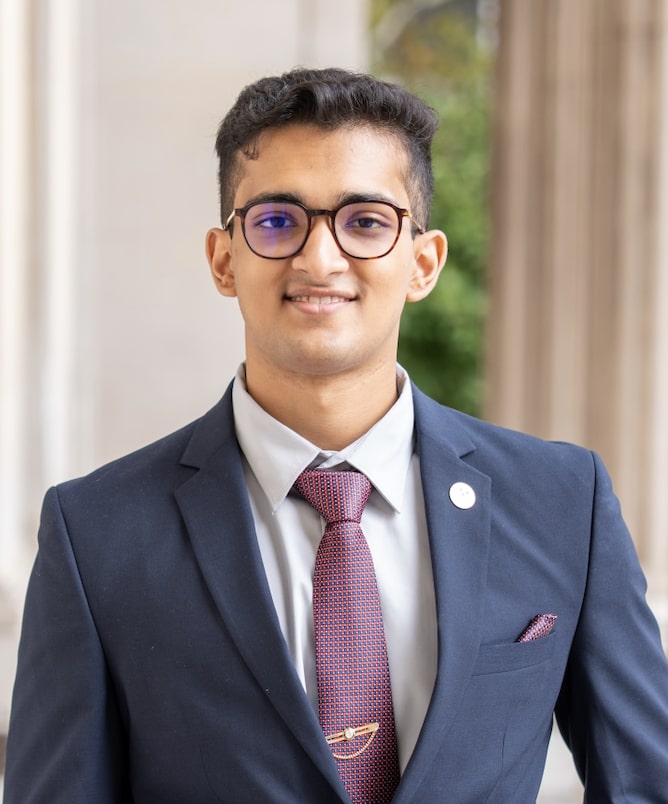
MS CS in Machine Learning. Building production NLP and multimodal systems.
I build ML systems that work on the internet. Started coding in Mumbai, now at Columbia—focused on the gap between research papers and production deployments.
Currently seeking Summer 2026 ML/AI internships where I can contribute to production systems at scale. Open to full-time post-graduation (December 2026).
Facilitating academic accommodations for students with disabilities by proctoring exams in modified testing environments. Ensuring equitable access to education while maintaining academic integrity and confidentiality standards.
Supporting behavioral research initiatives and data analysis projects at Columbia's Dean's Office. Applying statistical methods and ML techniques to research questions in organizational behavior and decision-making.
Specializing in Machine Learning with coursework in NLP, Applied ML, Algorithms, and Databases. Built production-grade projects including multimodal search systems, LLM cost optimization frameworks, and autonomous agent architectures. Published research on extractive summarization.
Developed and deployed ML models for real-world applications. Focused on model optimization, feature engineering, and production deployment pipelines. Collaborated with cross-functional teams to deliver data-driven solutions.
Built full-stack applications and backend systems. Implemented RESTful APIs, optimized database queries, and contributed to system architecture decisions. Gained experience in production software development and deployment workflows.
Production-grade ML systems that combine research rigor with engineering excellence
Multimodal Photo Search Engine
Built a semantic photo search system using CLIP and BLIP for natural language image queries. Enables users to search their photo library with descriptions like "sunset at the beach" or "my dog playing." Implemented zero-shot classification and cross-modal retrieval with FAISS for efficient similarity search.
Why it's impressive: Bridges vision and language modalities using state-of-the-art transformers. Handles semantic understanding, not just keyword matching. Production-ready with sub-200ms query latency on large image collections.
Cost-Optimized Model Selection Framework
Designed a routing system that dynamically selects between GPT-4, Claude, and Llama based on query complexity and cost constraints. Uses lightweight classifiers to predict optimal model choice, reducing inference costs by 40% while maintaining 95%+ quality.
Trade-offs considered: Balance between cost savings and response quality. Implemented fallback mechanisms for edge cases. Optimized routing latency to stay below 50ms overhead.
Intelligent Text Classification & Storage System
Built an autonomous agent that extracts, classifies, and stores information from unstructured text using Google Gemini API. Automatically processes documents, identifies key entities, and organizes data in Google Cloud Storage with intelligent tagging and retrieval mechanisms.
System design: End-to-end pipeline with text preprocessing, LLM-based classification, structured data extraction, and cloud storage integration. Deployed on Render with automated workflows.
ML-Powered Agricultural Decision Platform
AI-driven agricultural platform that recommends optimal crops, fertilizer strategies, and detects plant diseases using ML and deep learning. Built with Flask, PyTorch, and computer vision models. Processes soil data, weather patterns, and crop images to provide actionable insights.
Real-world impact: Helps farmers make data-driven decisions about crop selection and disease management. Combines traditional ML (for tabular data) with CNNs (for image classification).
RAG-Powered Healthcare AI
AI-powered medical assistant using Retrieval-Augmented Generation (RAG) and Chainlit. Retrieves relevant medical information from knowledge base and generates contextual responses. Built with vector databases for semantic search and LLMs for natural language understanding.
Technical approach: Combines embedding models for semantic retrieval with LLMs for response generation. Ensures factual accuracy by grounding responses in retrieved medical documents.
Published NLP Research
Published research on extractive text summarization techniques. Investigated graph-based methods, sentence ranking algorithms, and semantic similarity measures for automatic summary generation. Compared approaches on benchmark datasets and proposed optimizations.
Research contribution: Demonstrated ability to conduct rigorous research, implement experiments, and communicate findings. Shows depth in NLP fundamentals and academic writing.
I'm actively seeking Summer 2026 internships in ML/AI engineering. Open to full-time opportunities post-graduation (December 2026).
Or reach me directly:
smit.thakare@columbia.edu